

Global pass rates for exit-level professional accounting exams often hover around the 40% mark.
Failing students will either repeat these exams or quit their qualification journey. The levels they’ve completed were supposed to prepare them for those final exams (or filter them out if they were really not going to be able to complete the qualification). This raises an important question:
Why are committed students who have passed most of their academic journey, struggling to pass their exams at higher levels?
It’s tempting for teachers to tell students who are struggling to just copy what the successful students are doing. If we know the habits of high-achievers, shouldn’t those who are having trouble just do the same thing?
The problem is, this advice doesn’t account for what’s going on inside the student’s head—their core beliefs about learning and intelligence. These beliefs shape how they see obstacles, making it really difficult for them to adopt new study methods, even if those methods work for others.
As the exams get harder, these mental hurdles become a bigger problem. The system is unconsciously sorting students based on their psychological reaction to difficulty, not just how smart they are or how much they know. When things get tough, some students handle it, adapt their approach, and keep going because they are focused on mastering the material. Others, despite having the same talent, get overwhelmed and quit because they feel helpless.
Let’s slow down here, because what a lot of people may ‘hear’ here is that I’m saying these students are quitters, or they just don’t try hard enough, or they’re not prepared to work more. That’s not what I’m saying. So, hang tight and let me explain!
We’ve all heard of fixed and growth mindsets (researched and popularised by Carol Dweck), and we know that it’s good to have a growth mindset. The accounting profession says it’s valuable and important and your future success depends on having one. It allows you to learn, adapt and ‘stuff’. But there’s WAY more to it than that. And it’s the WAY MORE that we’re going to look at here. To do so, let’s look at the journey of two students.
A Tale of Two Students - Growther and Fixeder
These two students have passed years of previous exams and levels and are preparing for their higher level exams (Postgraduate; Board level; final CPA; ACCA etc).
While preparing for this exam, they both attempt a mock exam and both fail it. The Growther goes on to pass the final exam, while the Fixeder fails. Given the complexity and volume of work, initial perceptions may be that the Fixeder lacks the technical competence required to pass at that level.
Mindset research suggests something else: these two students have different interpretations of what that mock exam failure means, and, based on their beliefs about this, they will continue their preparation in different ways. It is the difference in their prep that will determine their success.
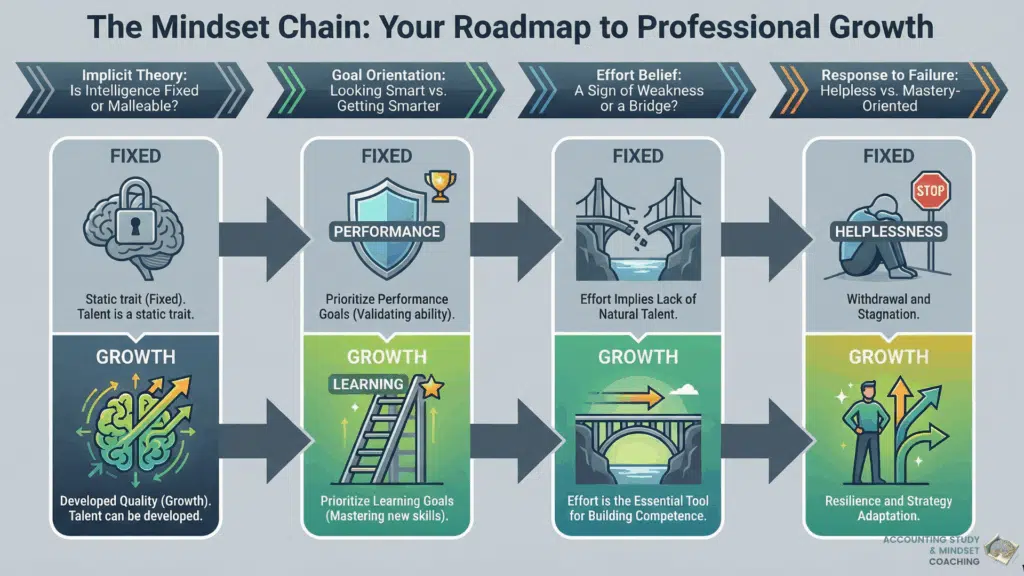
Mindset research calls it the Mindset Meaning System (MMS) and here’s how it works for our example:
MMS Element | Growther | Fixeder |
|---|---|---|
Implicit Belief (‘mindset’) | Growth – Intelligence is malleable (“I do not know it yet”) “I failed the mock exam because there’s clearly a gap in my understanding and now I know where it is, I can get some help to fix it” | Fixed – Intelligence is static (“You are either smart or you are not”) “I failed because I’m clearly not smart enough to pass this. It must MEAN that I can’t pass this. If I was smarter, I wouldn’t be struggling like this. I’d be able to do this already” |
Goal Orientation | Learning – Focus on improvement – developing competence “The purpose of the mock exam is to help me learn and it’s going to get me one step closer to passing” | Performance – Focus on validating intelligence; getting it right ‘now’; avoid looking incompetent “The mock exam has proven that I’m not smart enough to pass” |
Effort Belief | Effort and struggle are part of learning and are required for success “If I want to pass this, I may need to do something different, get help, go back to basics, I have to figure out what to change and improve” | Effort signals a lack of ability; Smart people do not struggle “If I were going to be able to pass, I wouldn’t be struggling so much. The fact that I can’t get it right means I’ll never be able to” |
Response to Setback & Failure (Observable outcome) | Mastery-oriented – Resilience; Strategy adaptation; Sustained effort; help-seeking “Let me take my mock exam to a lecturer to tell me what they advise me to do or change” | Helpless – Procrastination; Withdrawal; Exam deferral; Avoidance of mock questions; Avoidance of help-seeking; Higher anxiety “I’m so demotivated that I’m struggling to study. I’m so anxious and exhausted. I’m going to study more theory because that doesn’t make me feel so stupid. I don’t want my lecturer to know how useless I am at this point.” |
Can you see that the way they interpret the mock exam failure impacts the way they feel, and the way they study?
Our Fixeder is not a quitter, or lazy, or ‘stupid’, but their interpretation of the failure means that they’re more likely to study in ways that don’t help them. They are less likely to ask for help, they often ‘hide away’ in theory and revision, because questions make them feel ‘stupid’ and they want to avoid that feeling.
Over time, and with more academic struggles, you can imagine the higher anxiety levels of our Fixeder, the fear of feeling and looking stupid, because they believe that they SHOULD be able to do this by now. And if they can’t, perhaps it MEANS that they’ll never be able to do it. Perhaps it means that they’re not ‘smart enough’ for the qualification they’re trying to get.
These underlying beliefs and interpretations influence the way students study on a daily basis, it influences how they engage with their academic content and their lecturers. No matter how amazing their academic resources are, if someone feels stupid and feels like it ‘means’ that they’re not smart enough for this, they’re probably going to avoid situations that make them look and feel stupid or where other people might realise that they’re not smart enough.
These are concepts and challenges I come across with students I work with, at all levels, every single day. Fixeders are incredibly smart and capable, but their interpretation of ‘struggle’ is very embedded, very real, and in most cases, so unconscious that they don’t know it’s there.
This is not about ‘study harder’ and ‘don’t give up’. This is about shifting the way we see the world. This is about understanding that we may have limiting beliefs that get in the way of how we go about our studies.
Forget the terminology and psychological terms and consider whether you relate to this, for yourself, or your students. Think of situations when you’re under pressure, not necessarily time pressure, but the type of pressure where you’re just not sure whether you can do this.
Take a moment and consider how this impacts studying and anxiety levels – and watch this space. My focus in my work and my research is to help both students and educators understand this and help change these beliefs and interpretations. For now… be aware that what’s going on in your head, completely unconsciously, impacts your daily study habits.
References
- 40% Pass rate –
CPA pass rates in 2025 for Financial Accounting and Reporting (FAR) and Business Analysis and Reporting (BAR) were approximately 39% and 43%, respectively (AICPA & CIMA, 2025). ACCA reported similarly low outcomes at its Strategic Professional level, with Advanced Performance Management (APM) and Advanced Audit and Assurance (AAA) recording pass rates in the 30% range across 2024 and 2025 (ACCA, 2025)
Growth and Fixed Mindsets –
Carol Dweck – Mindset (Book); Mindset and Accounting Students; TED Talk